
What is Acceptance and Commitment Therapy (ACT)?
Acceptance and Commitment Therapy (ACT) is a cognitive behavioural therapy (CBT) that helps clients both effectively handle difficult thoughts and feelings and simultaneously live a meaningful, fulfilling life defined by chosen values and principles. Unlike traditional CBT, which aims to challenge, modify and eliminate thoughts, beliefs, etc. ACT instead endeavours to alter the way we respond to these thoughts and feelings, opening and freeing up an array of possibilities to realise our authentic selves in the world.
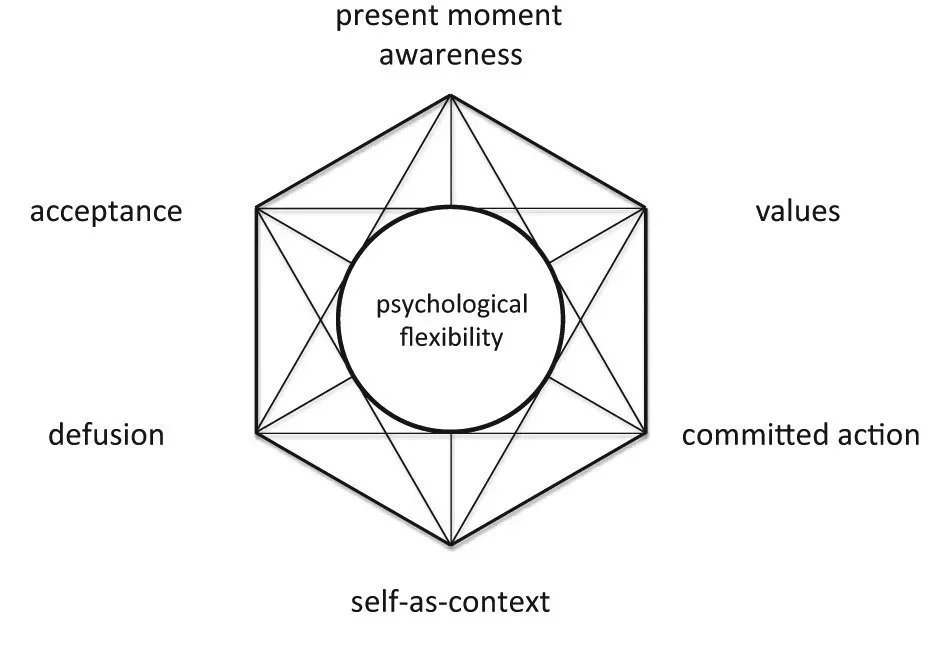
ACT is a process-based modality and works to cultivate what’s known as psychological flexibility, a metric of mental wellbeing in ACT, which rests on the following six components: defusion, acceptance, contacting the present moment, self-as-context, values and committed action, known collectively as the hexaflex (pictured on the left). Put simply, ACT focuses on building mindfulness and acceptance processes in the face of distressing thoughts and feelings, alongside facilitating commitment and behaviour change aligned to values that represent what a purposeful life looks like to the client.
In comparison to non-directive approaches, such as the person-centred approach, ACT practitioners typically conduct systematic assessments, case conceptualisations, behavioural analyses and treatment plans comprised of an array of skills and goals designed to bring about psychological flexibility. Upon the conclusion of ACT interventions, clients ordinarily demonstrate increased proficiency in contacting the present moment, gently and compassionately holding troublesome thoughts and feelings, and doing so intentionally in the service of living personally selected and defined values.
ACT is an evidence-based treatment that consistently shows efficacy in remediating depression, anxiety, obsessive-compulsive disorder, borderline personality disorder, dissociative disorders, PTSD, and many others. ACT is ideal for clients who want practical, pragmatic solutions to resolve their problems.
What is Person-Centred Counselling?
In contradistinction to Acceptance and Commitment Therapy (ACT), person-centred counselling is a non-directive approach that aims to create a therapeutic relationship characterised by the core conditions of empathy, congruence and unconditional positive regard. By creating a warm, non-judgmental and unconditionally caring environment, clients can explore deeply painful thoughts, feelings and behaviours at a pace set by them.
The absence of threat or pressure from the counsellor enables them to carefully and mindfully explore difficult thoughts, feelings and experiences from every conceivable angle. The therapist gently and sensitively helps the client pick up, turn around, disassemble and reassemble their internal experience to ever so gradually engender the development of new insights and solutions. Over time, clients learn more about themselves and begin to relate to themselves and others in more constructive and deeply authentic ways.
At the heart of person-centred psychology is what’s called the actualising tendency, which posits that everyone possesses the resources to heal and grow, with optimal movement dependent on exposure to certain relational qualities, such as empathy, respect and compassion. Under these interpersonal parameters, people discover and realise their innate potentialities and unlock the truest expression of themselves.
Unlike ACT, person-centred therapy is exclusively positioned on the construction of a therapeutic space conducive to undefended, unobstructed exploration. Person-centred therapy is ideal if you’re primarily concerned about learning more and more about yourself at a speed entirely governed by you. The therapist is there to facilitate this organic process.

My Approach
Each client is a separate and uniquely wonderful composition. Over the years, it became crystal clear that no therapeutic approach is one-size-fits-all. Internalising this, I have undergone further postgraduate training to enhance the breadth and depth of my practice, allowing greater opportunities to modify and adapt my approach to suit the needs of my clients.
From the beginning, some clients are clear on what approach they want to work with, while others are unsure and wish to experiment until they find one that resonates. Ultimately, what matters is that my service is adept at adapting when needed to promote the highest and most responsive care to the clients who seek my help.